Blog
How Many Items Do You Need to Sell to Reach Your Fundraising Goal?
How Many Items Do You Need to Sell to Reach Your Fundraising Goal?
How Many Items Do You Need to Sell to Reach Your Fundraising Goal?
Setting a fundraising goal is easy. Figuring out how many items your group actually needs to sell to reach that goal is where the math becomes useful.
Instead of simply telling participants, “We need to raise $5,000,” break the goal down into the number of items your group needs to sell and then into a realistic goal for each participant.
With a Dutch Mill Bulbs fundraiser, groups keep 50% profit on every item sold. That makes it easy to calculate exactly how much your group needs to sell to reach its fundraising goal.
How Do You Calculate a Fundraising Sales Goal?
Start with the amount of profit your organization wants to raise, not the total amount of sales.
To calculate how much your group needs to sell, divide your fundraising goal by the profit earned on each item.
For example, Dutch Mill Bulbs fundraiser items sell for $15 each, and participating organizations keep 50% profit. That means your group earns $7.50 per item sold.
How Many Items Do You Need to Sell to Raise $5,000?
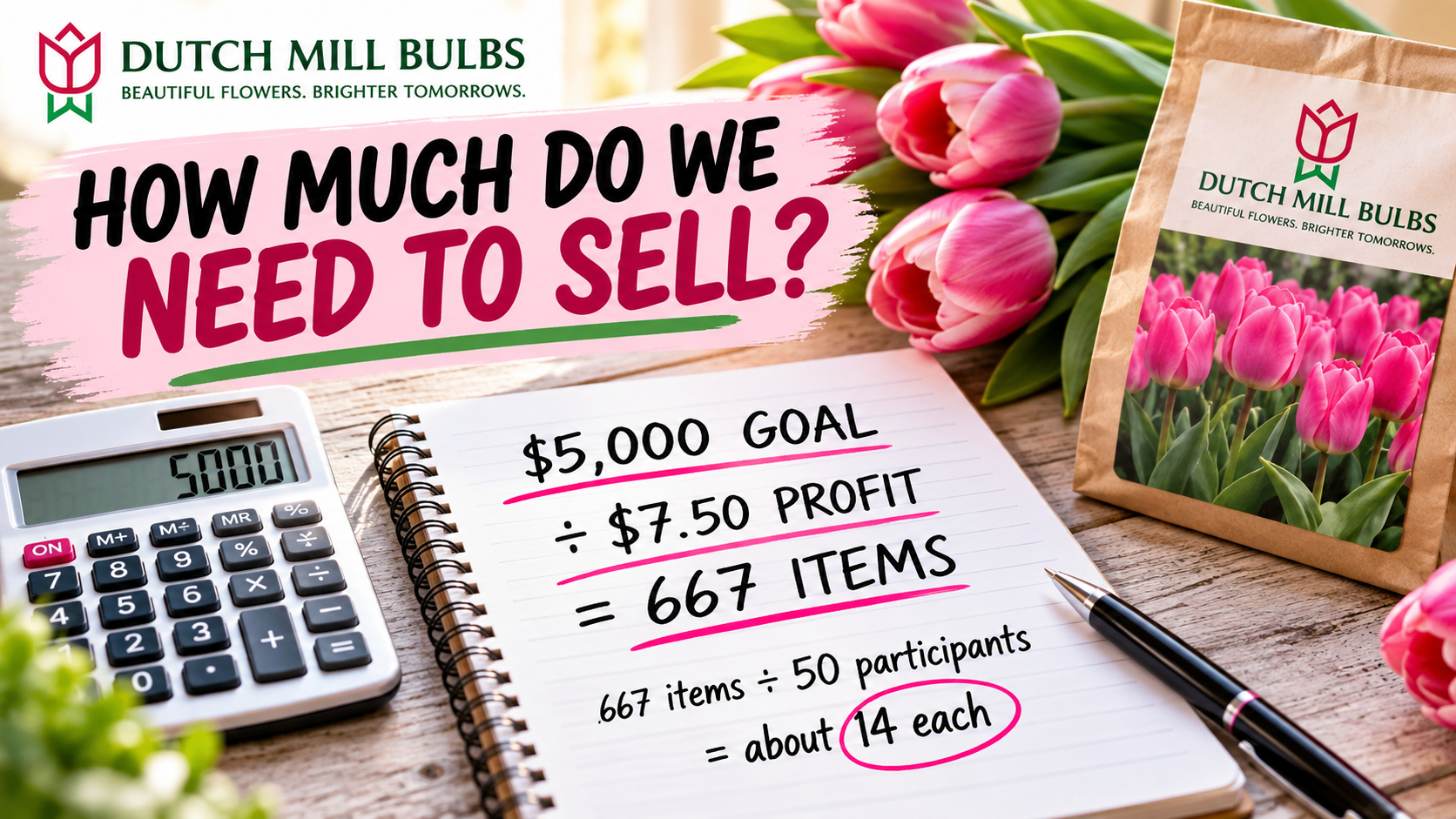
If your organization wants to raise $5,000 in profit, divide your $5,000 fundraising goal by the $7.50 profit earned on each $15 item.
$5,000 ÷ $7.50 = 667 items
That means your group would need to sell approximately 667 items to raise $5,000.
A goal of 667 items may sound intimidating at first. But the number becomes much more manageable when you divide it among everyone participating in the fundraiser.
How Do You Set a Fundraising Goal for Each Participant?
Once you know how many items your group needs to sell, divide that number by the number of people participating in the fundraiser.
For example, if your group needs to sell 667 items to raise approximately $5,000 in profit and you have 50 participants:
667 items ÷ 50 participants = about 14 items per person
Instead of telling everyone, “We need to raise $5,000,” you can give participants a much clearer goal: sell 14 items each.
Breaking a large fundraising goal into a small, specific target helps participants understand exactly what they can do to help the group succeed.
How Many Items Does Your Group Need to Sell?
Using $15 items with $7.50 profit per item, here are a few common fundraising goals and approximately how many items your group would need to sell:
$1,000 goal = 134 items
$2,500 goal = 334 items
$5,000 goal = 667 items
$7,500 goal = 1,000 items
$10,000 goal = 1,334 items
Your group’s numbers may look different depending on its fundraising goal, but the formula stays the same: fundraising goal ÷ profit per item = number of items you need to sell.
How Does Participation Affect Your Fundraising Goal?
The more people who actively participate in your fundraiser, the fewer items each person needs to sell to reach the same overall goal.
Using our $5,000 fundraising goal of approximately 667 items:
25 participants = about 27 items each
50 participants = about 14 items each
75 participants = about 9 items each
100 participants = about 7 items each
This is why participation can matter just as much as the fundraising goal itself. Getting more members involved can make the individual sales goal feel much more achievable.
Before your fundraiser begins, show participants the math. A specific goal like “If 50 of us each sell 14 items, we’ll reach our $5,000 goal” is easier to understand than simply asking everyone to sell as much as they can.
Why Should You Tell Participants What the Fundraising Goal Is For?
A fundraising goal is more motivating when participants and supporters understand why the money is being raised.
Instead of saying, “Our goal is to raise $5,000,” explain what reaching $5,000 will make possible. Maybe it pays for new uniforms, a class trip, playground equipment, church programs, competition expenses, or a community project.
Then connect that purpose to the individual goal:
“Our goal is to raise $5,000 for our class trip. If 50 students each sell about 14 items, we can reach our goal.”
Now participants know what they are working toward, how much needs to be raised, and exactly what their part is in reaching the goal.
Supporters benefit from knowing the purpose, too. When someone understands what their purchase is helping accomplish, the fundraiser becomes about more than simply buying a product.
How Do You Set a Realistic Fundraising Goal?
A good fundraising goal should be ambitious enough to motivate your group but realistic enough that participants believe they can reach it.
Start by asking three questions:
How much money does your organization actually need to raise?
How many people are likely to participate?
How many items can each participant reasonably sell?
For example, if you have 40 active participants and believe each person can reasonably sell 10 items, your group could plan for approximately 400 items sold.
At $7.50 profit per item, 400 items would generate approximately $3,000 in profit.
Working backward from both your financial need and your expected participation can help you set a fundraising goal that makes sense for your organization.
Frequently Asked Questions About Fundraising Goals
What is the formula for calculating a fundraising sales goal?
Divide the amount of profit your organization wants to raise by the profit earned on each item. For example, a $5,000 goal divided by $7.50 profit per item equals approximately 667 items.
Should a fundraising goal be based on sales or profit?
Base your goal on the amount of profit your organization actually needs to raise. From there, calculate the sales needed to generate that profit.
Should every participant have an individual fundraising goal?
Giving participants a specific individual goal can make a large group goal easier to understand. Divide the total number of items your group needs to sell by the number of expected participants to create a simple per-person target.
Ready to Reach Your Fundraising Goal?
Setting a clear fundraising goal gives your organization a target. Breaking that goal into a realistic number of items per participant gives your members a plan for reaching it.
Dutch Mill Bulbs makes the math simple. Groups keep 50% profit on every item sold, with no upfront costs and no minimum sales requirements. Organizations can sell through traditional paper brochures, online with a personalized fundraising link and QR code, or use both methods together.
Ready to put the math to work? Start a Dutch Mill Bulbs fundraiser and set a goal your group can work toward together.