Blog
How to Choose the Right Fundraiser for Your School, Team, Church or Nonprofit
How to Choose the Right Fundraiser for Your School, Team, Church or Nonprofit
How to Choose the Right Fundraiser for Your School, Team, Church or Nonprofit
Choosing a fundraiser can feel surprisingly complicated.
Should you sell a product? Hold an event? Run everything online? Ask members to sell in person? And how much of each sale does your organization actually get to keep?
Whether you’re raising money for a school, PTO or PTA, sports team, booster club, church, nonprofit, Scout troop or pack, youth group, garden club, animal rescue, civic club, or community organization, the best fundraiser isn’t necessarily the one everyone else is doing.
The right fundraiser is one that fits your financial goal, your participants, your supporters, and the amount of time your volunteers have available.
Before committing to your next fundraiser, here are 10 questions worth asking.
1. How Much Profit Will Your Organization Actually Earn?
Start with the number that matters most: how much money does your organization keep?
Don’t look only at how much a product sells for. Look at the actual profit your organization receives from each sale.
For example, Dutch Mill Bulbs fundraising organizations earn 50% profit on every item sold.
If an item sells for $15, the organization earns $7.50.
That makes it much easier to calculate how much your group needs to sell to reach its goal.
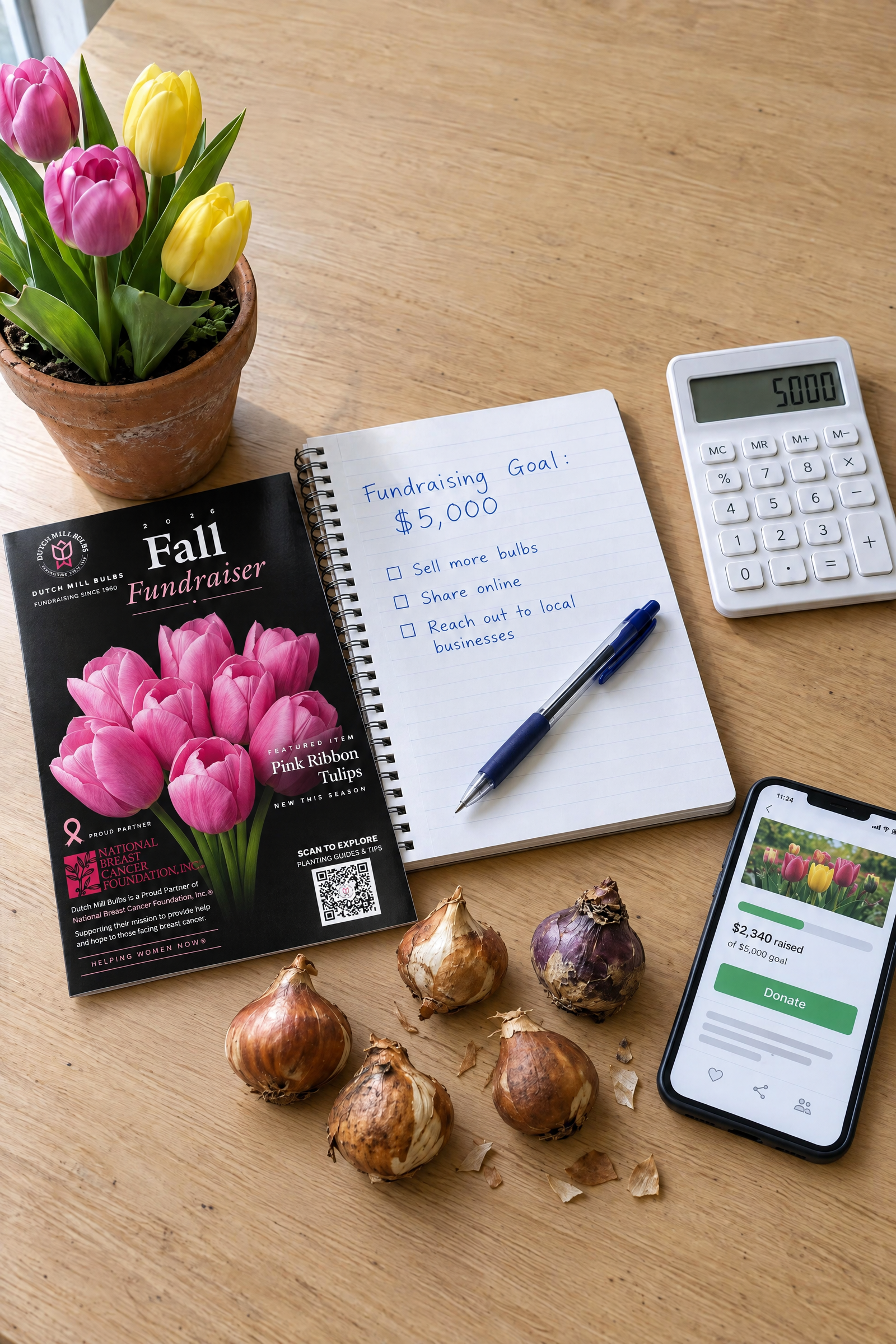
If your goal is $5,000:
$5,000 ÷ $7.50 = approximately 667 items
With 50 participating members:
667 ÷ 50 = about 14 items per participant
A big fundraising goal suddenly becomes a much more understandable individual goal.
2. Are There Upfront Costs?
Before choosing a fundraiser, find out whether your organization has to spend money before making its first sale.
Ask:
- Do we have to purchase inventory?
- Are there registration fees?
- Do we have to buy fundraising materials?
- What happens if we don’t sell everything?
For schools, Scout troops and packs, teams, nonprofits, clubs, and smaller organizations working with limited budgets, upfront expenses can add unnecessary financial risk.
A fundraiser with no upfront costs allows the organization to begin fundraising without first taking money out of its budget.
Dutch Mill Bulbs fundraisers have no upfront costs.
3. Is There a Minimum Sales Requirement?
Minimum sales requirements can be especially important for smaller organizations.
A fundraiser that works beautifully for a school with hundreds of students may not make sense for a Cub Scout pack, Scout troop, youth group, garden club, or small nonprofit with 15 active members.
Before signing up, ask whether you’re required to sell a certain number of items or reach a specific dollar amount.
Dutch Mill Bulbs has no minimum sales requirement, which means both small and large organizations can participate.
4. How Much Does Each Participant Need to Sell?
Setting a goal like “We need to raise $5,000” tells your members what the organization wants.
It doesn’t necessarily tell them what they need to do.
Instead, calculate the fundraising goal per participant.
If 50 people need to sell approximately 667 items to reach the organization’s goal, each participant’s target becomes about 14 items.
That’s much easier to understand than simply announcing a $5,000 goal and hoping everyone somehow produces it.
The more specific the individual goal, the easier it is for participants to understand their part in reaching the larger goal.
For a Scout troop or pack, sports team, classroom, or other member-based organization, this also gives leaders a simple way to explain the goal to participants and families.
5. Can Supporters Buy Online?
Online selling can dramatically expand who your participants can reach.
Instead of being limited to neighbors, coworkers, friends, and family members who live nearby, participants can share their fundraiser with people in other areas.
Before choosing a fundraiser, find out:
- Does the organization receive its own fundraising link?
- Is there a QR code?
- Can participants share the fundraiser through text, email, and social media?
- Are online orders tracked?
- Are online supporters able to have purchases shipped directly to them?
Dutch Mill Bulbs fundraising groups can use a personalized fundraising link and QR code, and online fundraiser orders can be shipped directly to supporters within the 48 contiguous United States.
That can be especially helpful for schools, teams, Scout troops and packs, and other organizations whose members have friends and family outside their immediate community.
6. Can Participants Sell in Person Too?
Online fundraising is convenient, but not every supporter wants to shop online.
Some organizations still have tremendous success with traditional face-to-face fundraising.
That’s why it can be useful to choose a fundraiser that doesn’t force your organization into only one selling method.
Dutch Mill Bulbs organizations can sell online, with traditional paper brochures, or use both methods together.
A Scout might share a brochure with neighbors while a parent sends the online fundraiser link to relatives in another state. A student might sell in person while a PTO shares its QR code through school communications.
Giving participants more than one way to sell can make the fundraiser easier to fit into everyday life.
7. Who Handles the Orders and Shipping?
This question is easy to overlook until your fundraiser ends and someone realizes there are hundreds of products that need to go somewhere.
Find out what happens after someone places an order.
For online Dutch Mill Bulbs fundraiser orders, products can be shipped directly to the supporter.
Brochure orders are delivered to the fundraising organization for distribution.
Understanding fulfillment before you begin can prevent unpleasant surprises when your fundraiser ends.
Nobody wants to discover on delivery day that “fundraising chair” secretly meant “temporary warehouse manager.”
8. How Much Work Will Volunteers Have to Do?
Profit matters, but volunteer time has value too.
A fundraiser may sound wonderful until you discover that someone has to organize inventory, manage payments, coordinate an event, chase missing orders, answer participant questions, and spend an entire Saturday running it.
Consider how much time your organization realistically has available.
Ask:
- How complicated is setup?
- How will sales be tracked?
- Who collects orders?
- Who handles money?
- Who distributes products?
- How much communication will leaders need to manage?
This is especially important for volunteer-led PTOs, Scout troops and packs, booster clubs, churches, nonprofits, and community organizations where the people running the fundraiser already have plenty to do.
Sometimes a simpler fundraiser that people will actually run successfully is more valuable than an elaborate fundraiser with impressive theoretical results.
9. Is It Something Supporters Actually Want?
This one sounds obvious, but it gets overlooked surprisingly often.
Your members aren’t simply selling a product. They’re asking friends, relatives, coworkers, neighbors, and community members to spend money.
Consider whether the product or experience gives supporters something they genuinely value.
Flower bulbs offer something different from many traditional fundraising products because supporters receive something they can plant, grow, and enjoy.
For organizations looking for a fundraiser connected to gardening, nature, beautification, and growing something rather than consuming something, that can be particularly appealing.
10. Does the Fundraiser Fit Your Organization?
There isn’t one perfect fundraiser for every organization.
A large school may have very different needs from a small Scout troop, Cub Scout pack, garden club, church group, sports team, or nonprofit.
Consider:
Your audience. Who is most likely to support you?
Your goal. How much money actually needs to be raised?
Your timeline. How quickly do you need the funds?
Your participants. How many people will realistically participate?
Your volunteers. How much time can they give?
Your selling methods. Do you need online sales, in-person sales, or both?
Your supporters. What are they actually likely to purchase?
The right fundraiser should fit your organization instead of forcing your organization to fit the fundraiser.
Fundraiser Evaluation Checklist
Before choosing your next fundraiser, compare your options using these questions:
| What to Compare | What to Ask |
|---|---|
| Profit | How much does our organization actually keep? |
| Upfront cost | Do we have to spend money before we begin? |
| Minimum sales | Are we required to sell a certain amount? |
| Participant goal | How much does each person realistically need to sell? |
| Online selling | Can supporters purchase through a link or QR code? |
| In-person selling | Is a brochure or other offline option available? |
| Order fulfillment | Who ships, sorts, and distributes the orders? |
| Tracking | Can leaders easily see online sales and progress? |
| Volunteer workload | How much time will the fundraiser require? |
| Supporter appeal | Is this something people will actually want to buy or support? |
A fundraiser shouldn’t just look good on paper. It should make sense for the people who have to run it.
How Does a Dutch Mill Bulbs Fundraiser Compare?
If you’re considering flower bulb fundraising, here’s what a Dutch Mill Bulbs fundraiser includes:
- 50% profit on every fundraiser item sold
- No upfront costs
- No minimum sales requirements
- Online fundraising
- Traditional brochure fundraising
- Option to use online and brochure sales together
- Personalized fundraising link and QR code
- Online sales tracking
- Direct shipping for online fundraiser orders
- Grow Guarantee
- Fall and spring fundraising seasons
Flower bulb fundraising can work for schools, PTO and PTA groups, sports teams, booster clubs, churches, nonprofits, Scout troops and packs, youth groups, garden clubs, animal rescues, civic organizations, and other community groups.
What Is the Best Fundraiser for Your Organization?
The best fundraiser isn’t necessarily the one with the flashiest product or the biggest promises.
It’s the fundraiser that gives your organization a realistic path from:
“We need to raise this much money.”
to:
“Here’s exactly how we’re going to do it.”
Compare the profit. Check the costs. Understand the workload. Calculate the participant goal. And make sure you’re offering supporters something they’re actually willing to purchase or support.
If flower bulb fundraising checks those boxes for your organization, learn more about how a Dutch Mill Bulbs fundraiser works.
Whether you’re planning a fundraiser for a school, team, church, nonprofit, Scout troop or pack, or community organization, you can choose the selling method that works best for your group and start with no upfront costs or minimum sales requirements.
Ready to grow your fundraising goal?
Start a fundraiser